As crypto regulation develops across the European Union, new reporting standards are being introduced to increase transparency of digital asset activity. One of the most important upcoming frameworks is DAC8, which extends tax reporting obligations to crypto-asset service providers.
Understanding how this works is important for anyone using centralized exchanges or self-custodial wallets.
What is DAC8?
DAC8 is the eighth update of the EU Directive on Administrative Cooperation. Its purpose is to improve tax transparency by requiring automatic information exchange between service providers and tax authorities within the European Union.
In practice, it introduces reporting obligations for certain crypto-asset service providers, similar to systems already used in traditional finance.
Who is required to report under DAC8?
DAC8 generally applies to crypto-asset service providers that offer custodial or intermediary services to users.
This typically includes:
- centralized exchanges
- custodial wallet providers
- brokerage platforms
- other intermediaries facilitating crypto transactions
These providers are expected to:
- verify user identity through KYC procedures
- record relevant transaction activity
- report required data to tax authorities
What kind of information is reported?
Depending on the final implementation in each EU country, reporting may include:
- user identification data
- account balances
- transaction history such as swaps, purchases, and sales
- transfers involving reportable platforms
- realized gains or losses in some cases
This information is shared between tax authorities in EU member states to improve cross-border transparency.
DAC8 is active as of 1 January 2026, with reporting obligations being rolled out by service providers according to the implementation timelines set by EU member states.
This means that reporting infrastructure is no longer theoretical — it is part of the active regulatory environment, and compliance processes are being integrated by crypto-asset service providers.
How does this affect centralized exchange users?
If you use a centralized exchange, your activity will generally:
- be linked to a verified identity
- be recorded by the platform
- be reportable to tax authorities under DAC8 rules
This increases transparency for regulators but reduces transactional privacy compared to decentralized alternatives.
What about self-custodial wallets?
Self-custodial wallets operate differently from centralized intermediaries.
In general, a self-custodial wallet:
- does not hold or control user funds
- does not execute transactions on behalf of users
- does not function as a traditional intermediary between users and counterparties
Because of this structure, self-custodial wallets are typically less directly involved in DAC8 reporting obligations, which primarily target intermediaries providing custody, brokerage, or exchange services.
However, classification depends on how a product is structured and what additional services it provides, so regulatory interpretation may vary.
About Wigwam and self-custody
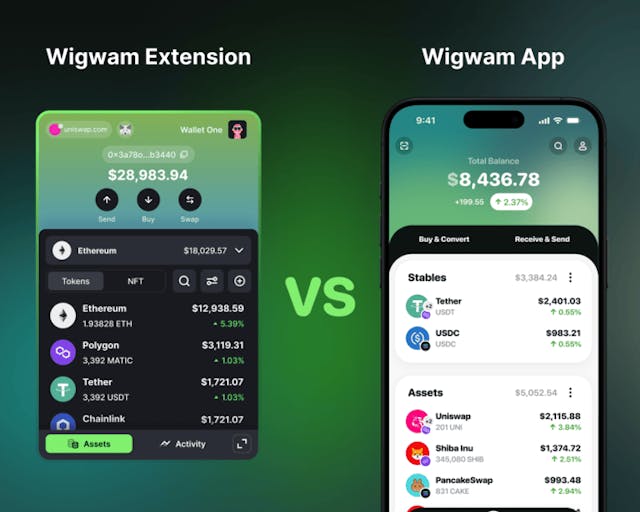
Wigwam is a self-custodial crypto wallet, meaning users retain full control over their private keys and digital assets at all times.
Because of this architecture:
- users can store, send, receive, and swap crypto directly from their own wallet
- transactions are executed by the user, not by a custodial intermediary
- asset control is never transferred to Wigwam or any third party
In a self-custodial model, wallet providers do not act as account holders or financial intermediaries. This means that user funds remain under user control, and the wallet itself does not operate like a centralized exchange.
Wigwam is designed to minimize data collection at the application level, so user activity within the wallet is not used for financial reporting purposes and is not shared as account-level transaction data with external services for regulatory reporting.
However, as with any blockchain-based system, transactions occur on public networks, and users should always be aware that blockchain activity itself may be independently observable on-chain.
Wigwam’s approach focuses on giving users full autonomy over their assets while reducing reliance on centralized intermediaries.
Important clarification
Self-custody does not remove tax obligations.
Even when using a self-custodial wallet:
- users remain responsible for reporting taxable events in their jurisdiction
- blockchain activity may still be analyzed by tax authorities using other methods
- regulatory frameworks may continue to evolve over time
The key distinction is not whether taxes apply, but whether a third-party intermediary automatically reports user activity.